Home › Guides › The State of GPSR Compliance on Shopify in 2026
The State of GPSR Compliance on Shopify in 2026
By Karim El Achaq, founder of EUReady · Last updated: 6 July 2026
- We scanned the public product pages of 960 live Shopify stores selling to the EU in July 2026.
- Only 1.7% showed all three GPSR-required elements; 98.3% were missing at least one.
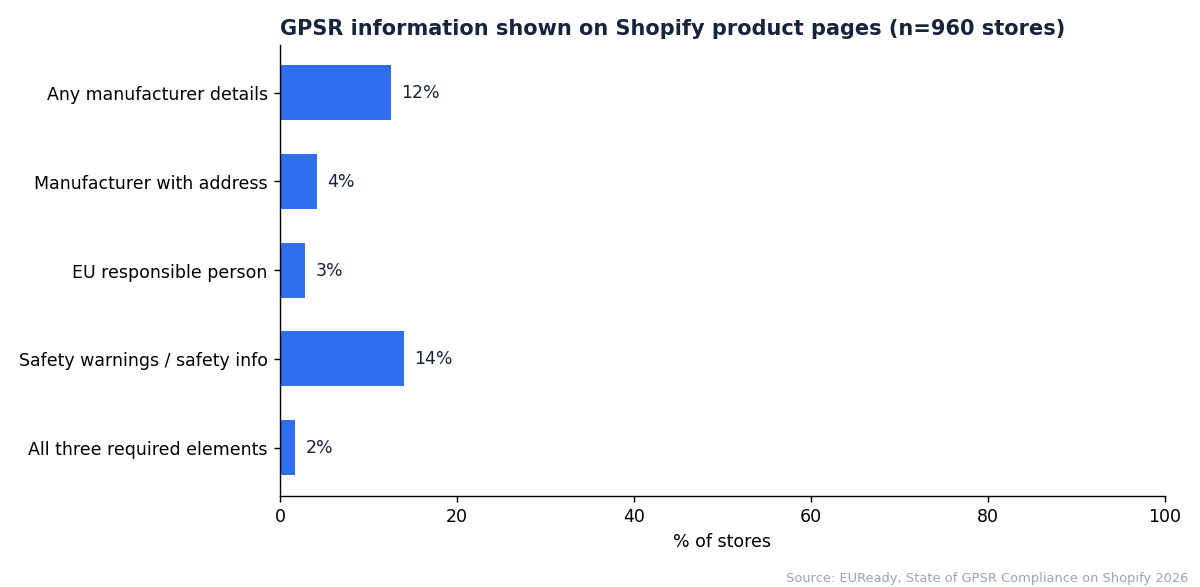
- The hardest requirement is the EU responsible person: only 2.8% of stores named one on the listing.
- Safety information was shown by 14% and manufacturer details by 12.5%.
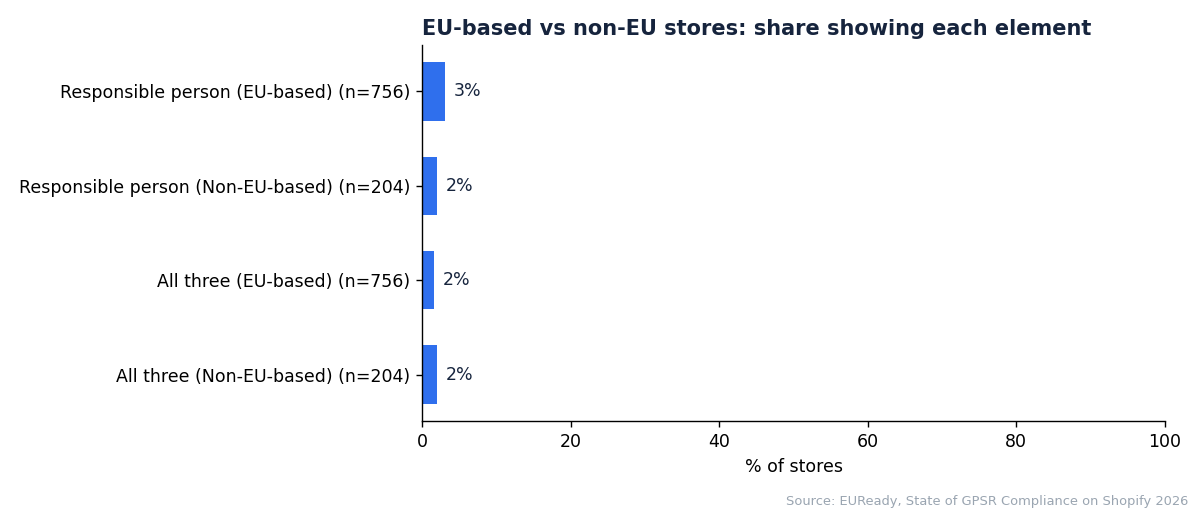
- Being based in the EU barely helps: 98.4% of EU-based stores are missing at least one required element, versus 98% of non-EU stores.
- Method and limitations are published in full; figures are conservative floors and no store is named.
How many Shopify stores actually show the GPSR information the law requires?
Very few. Of the 960 EU-facing Shopify stores we scanned, only 1.7% displayed all three GPSR-required elements on their product pages, while 98.3% were missing at least one. The single hardest requirement is the EU responsible person: just 2.8% of stores named one on the listing. GPSR has been in force since 13 December 2024, so this is not a grace-period gap: it is the steady state more than eighteen months in.
Which GPSR requirement do stores miss most often?
The EU responsible person, by a wide margin. Safety information is the element stores are most likely to show, because much of it (burn instructions, choking warnings, external-use notes) is already part of normal product copy. A named EU responsible person is different: it costs money to appoint one and there is no reason to add it unless you know GPSR requires it. That is exactly why it is the clearest signal of who has actually done the compliance work.
| GPSR-required element | Shown on product page | Missing |
|---|---|---|
| Safety information / warnings | 14% | 86% |
| Manufacturer details | 12.5% | 87.5% |
| EU responsible person | 2.8% | 97.2% |
| All three together | 1.7% | 98.3% |
Which product categories are least compliant?
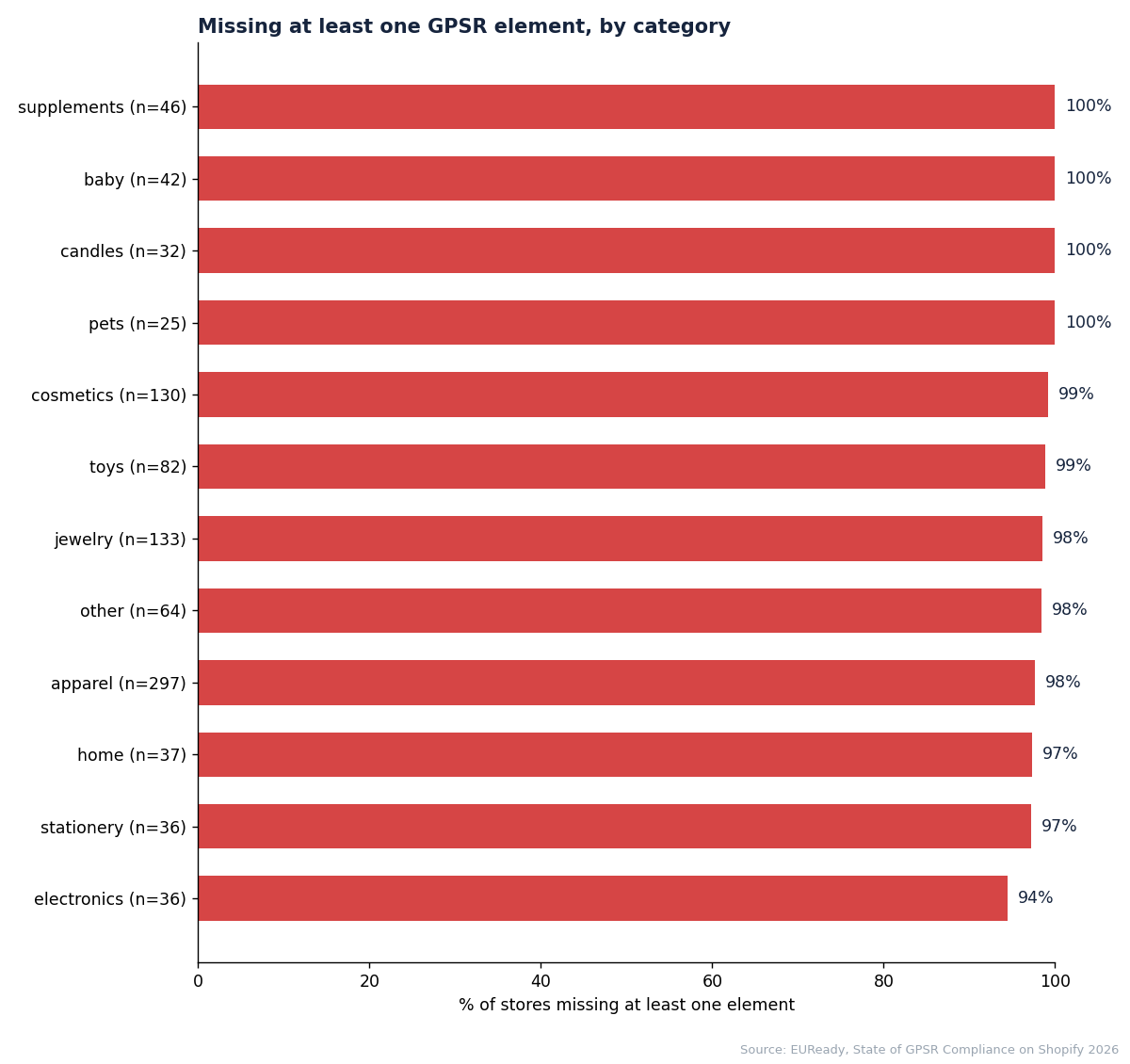
Compliance is low in every category, and the categories with the highest safety stakes are not the most compliant. Among safety-critical categories, not a single one of the 42 baby products stores we checked showed all three elements, and candle, cosmetics and toy stores were no better than jewelry or clothing despite carrying fire, chemical and choking risks. The strongest category in the whole sample, electronics and accessories, still only reached 5.6%. That is the finding regulators and journalists tend to care about most: the riskiest listings are not the ones getting compliance right.
| Category | Stores | EU responsible person | Safety info | Manufacturer | All three |
|---|---|---|---|---|---|
| Supplements | 46 | 0% | 30.4% | 13% | 0% |
| Baby products | 42 | 0% | 26.2% | 21.4% | 0% |
| Candles and home fragrance | 32 | 0% | 31.2% | 12.5% | 0% |
| Pet products | 25 | 0% | 16% | 16% | 0% |
| Cosmetics and skincare | 130 | 2.3% | 15.4% | 9.2% | 0.8% |
| Toys | 82 | 2.4% | 23.2% | 14.6% | 1.2% |
| Jewelry | 133 | 2.3% | 5.3% | 10.5% | 1.5% |
| Other | 64 | 3.1% | 7.8% | 7.8% | 1.6% |
| Clothing and textiles | 297 | 3.7% | 9.8% | 11.4% | 2.4% |
| Homeware and ceramics | 37 | 2.7% | 18.9% | 24.3% | 2.7% |
| Stationery | 36 | 8.3% | 11.1% | 16.7% | 2.8% |
| Electronics and accessories | 36 | 5.6% | 11.1% | 13.9% | 5.6% |
Does it depend on where the store is based?
The gap is not only a non-EU problem. Among the 756 EU-based stores in the sample, only 3% showed an EU responsible person on the product page and 1.6% showed all three elements. Among the 204 stores based outside the EU, the figures were 2% and 2%. Being established in the EU makes a manufacturer address easy, but it does not make the missing safety and responsible-person disclosures appear on the listing.
| Store country | Stores | EU responsible person | All three elements |
|---|---|---|---|
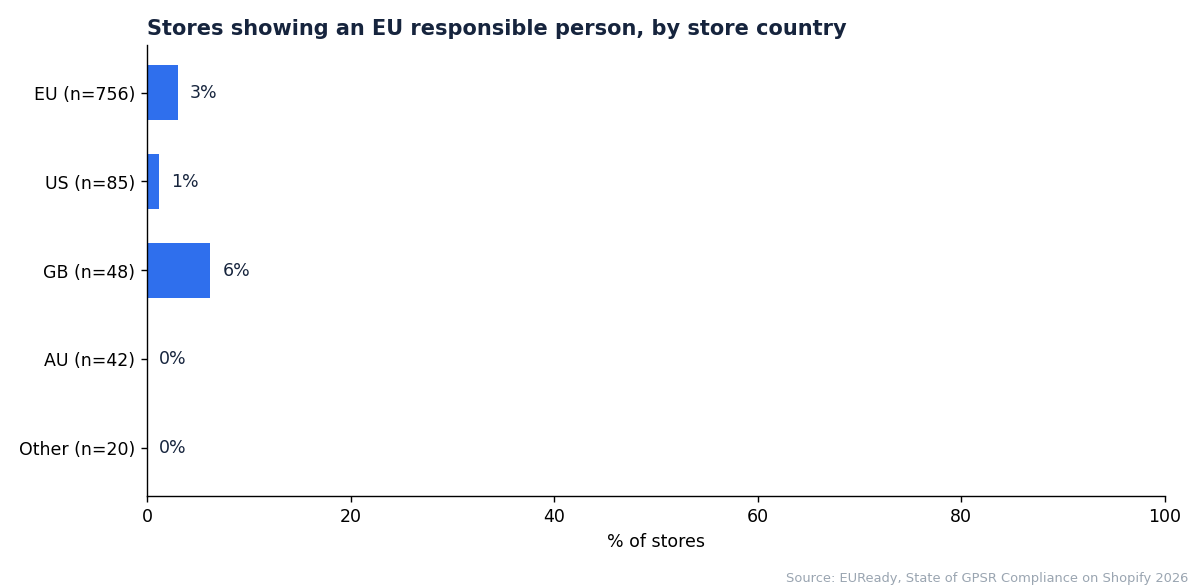
| EU-based | 756 | 3% | 1.6% |
| United States | 85 | 1.2% | 1.2% |
| United Kingdom | 48 | 6.2% | 6.2% |
| Australia | 42 | 0% | 0% |
| Other | 20 | 0% | 0% |
What does this mean for a Shopify store selling to the EU?
If your product pages do not show manufacturer details, an EU responsible person and safety information, you are in the 98.3% majority, and that is a legal exposure, not a stylistic choice. Under GPSR, online listings aimed at EU consumers must carry this information before the sale, and marketplaces and national authorities can order non-compliant listings taken down. The fix is mechanical: gather the details once, then display them on every listing.
- Add manufacturer identification (name, postal address, email) to every product.
- Appoint an EU responsible person if neither you nor your manufacturer is established in the EU, and show their name and contact details. See our responsible person cost guide for real price ranges.
- Write category-appropriate safety information. Our free warning generator produces a starting block by category.
- Render it on the page, not just in a policy footer. On Shopify this is metafields plus a theme block: see the metafields guide.
Methodology
Between 5 and 6 July 2026 we assembled a sample of live Shopify stores that
sell to EU consumers, drawn from public "best Shopify stores" listings and public
top-store directories across the United States, United Kingdom, Canada, Australia,
Germany, France and the Netherlands, plus stores we had catalogued in our own
outreach. We confirmed each store runs on Shopify (via its public storefront and
open /products.json endpoint) and kept only stores with a signal that
they sell into the EU (an EU country setting, EUR pricing, or an explicit shipping
policy covering the EU). The sample is not evenly spread across countries: it is dominated by France (599), Germany (86), the United States (85), the United Kingdom (48), Australia (42). This reflects where large public store directories exist, and it means the EU-based segment is mostly French. We therefore report each country separately, and the same pattern of very low disclosure holds in the United States, United Kingdom and Australia too, so the finding is not an artefact of one market. For each store we scanned up to three public product
pages (first, middle and last of the catalog) and checked the rendered text for
three GPSR elements: manufacturer identification, an EU responsible person or
authorised representative, and safety warnings or safety information, in English,
German and French. Where a store used a dedicated GPSR app widget, we credited it
as showing all three, even though the content loads client-side, so our
"missing" figures are conservative floors. We scanned politely: an honest
user-agent, at least two seconds between requests to any store, and public pages
only. The final sample is 960 stores that met every criterion and
returned at least one readable product page.
Limitations
- The sample skews toward established, visible stores. It is built from "top stores" lists and directories, so it under-represents the long tail of smaller stores, which is very likely less compliant, not more. Read the headline numbers as an optimistic bound.
- We read three product pages per store, not the whole catalog. A store could show the information on pages we did not sample.
- We read rendered HTML, so information injected purely by client-side scripts (beyond the GPSR app widgets we detected) can be missed. This again pushes our "missing" rate down, not up.
- Detection is keyword-based in English, German and French. Stores presenting the information only in other EU languages may be undercounted.
- "Sells to the EU" is inferred from country setting, currency and shipping policy, not confirmed at checkout for every store.
We are the team behind EUReady, a Shopify app that scans stores for missing GPSR information and fills the gaps, so we have an interest in this problem being real. That is also why we are showing our method and our raw aggregates rather than a single number: the figures are meant to be checkable, and we will share the anonymised aggregate data on request. No individual store is named, and we do not identify any store as non-compliant.
Change log
- 6 July 2026: first edition published. Sample of 960 EU-facing Shopify stores scanned 5 to 6 July 2026.
Check your store for free
EUReady scans every product in your Shopify store, shows you exactly what GPSR and EPR info is missing, and fixes it in one click. Now live on the Shopify App Store.
Install EUReady, free scanFree scan for every store. All features free up to 10 products. No credit card.
Frequently asked questions
What share of Shopify stores comply with GPSR on their product pages?
In our July 2026 scan of 960 EU-facing Shopify stores, only 1.7% displayed all three GPSR-required elements (manufacturer details, EU responsible person, and safety information) on their product pages. 98.3% were missing at least one.
Which GPSR requirement do stores miss most?
The EU responsible person. Only 2.8% of the stores we scanned named one on the listing, versus 14% for safety information. Naming a responsible person costs money and signals that a store has done the compliance work.
How was the study conducted?
We scanned up to three public product pages per store and checked the rendered text for the three GPSR elements, in English, German and French. We only included stores confirmed to run on Shopify and showing a signal that they sell to the EU. Where a store used a GPSR app widget we credited it as compliant, so the missing rates are conservative floors.
Does GPSR apply to stores based outside the EU?
Yes. GPSR applies to any product made available to EU consumers, regardless of where the seller is based. A non-EU store selling to EU customers must show manufacturer details, appoint and display an EU responsible person, and provide safety information on the listing.
Official sources
This guide is general information for online sellers, based on publicly available EU legislation. It is not legal advice. Regulations evolve and national rules differ: for decisions that matter to your business, confirm with a qualified professional or the official sources linked above.